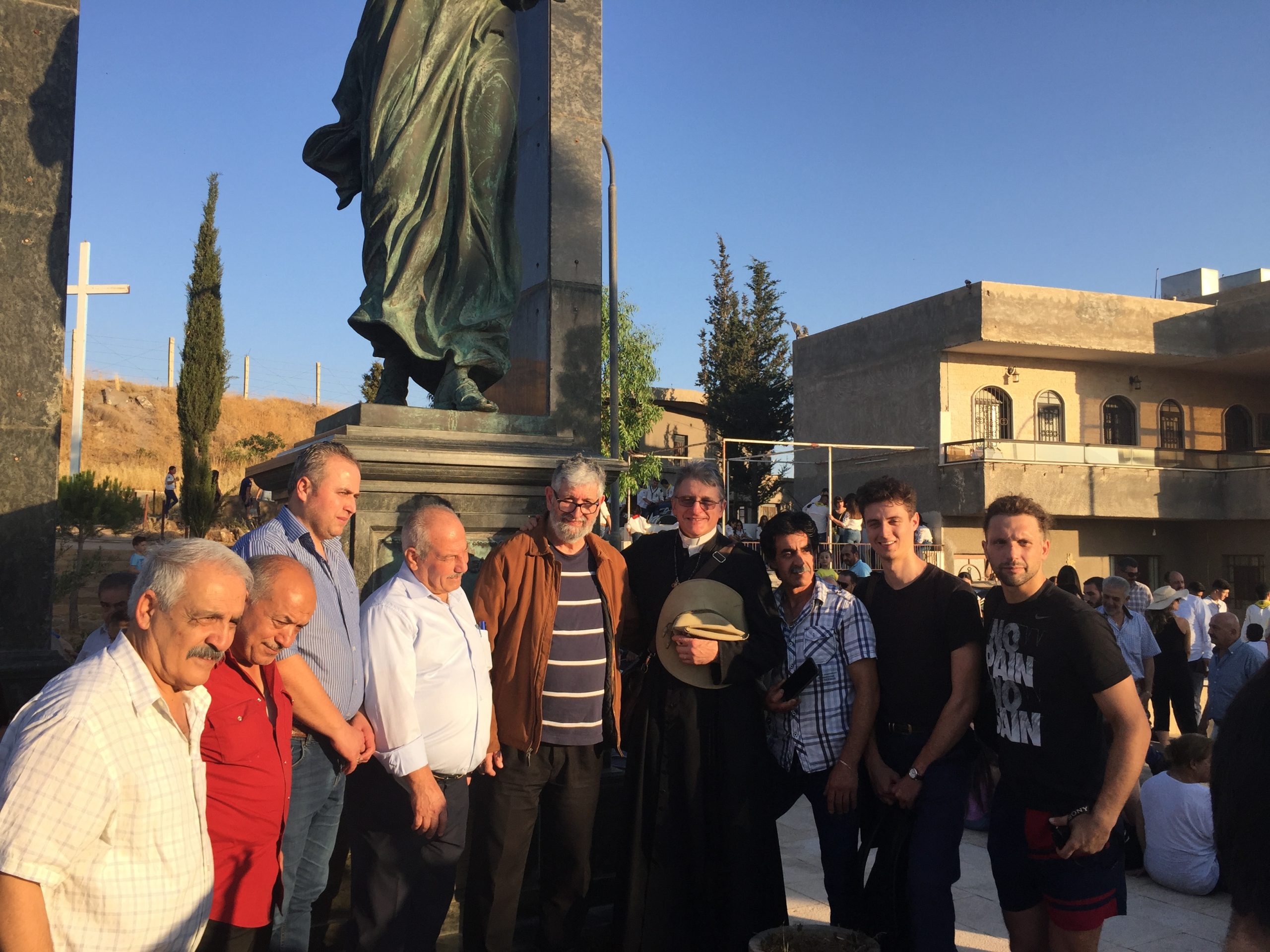
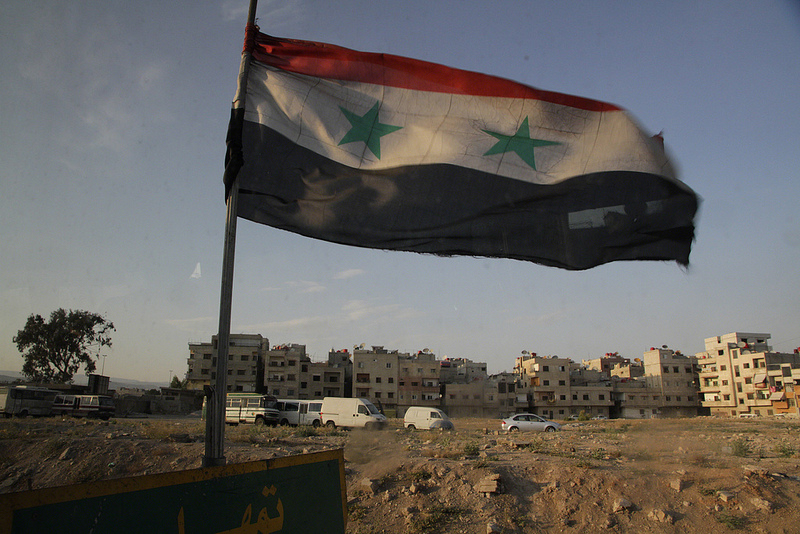
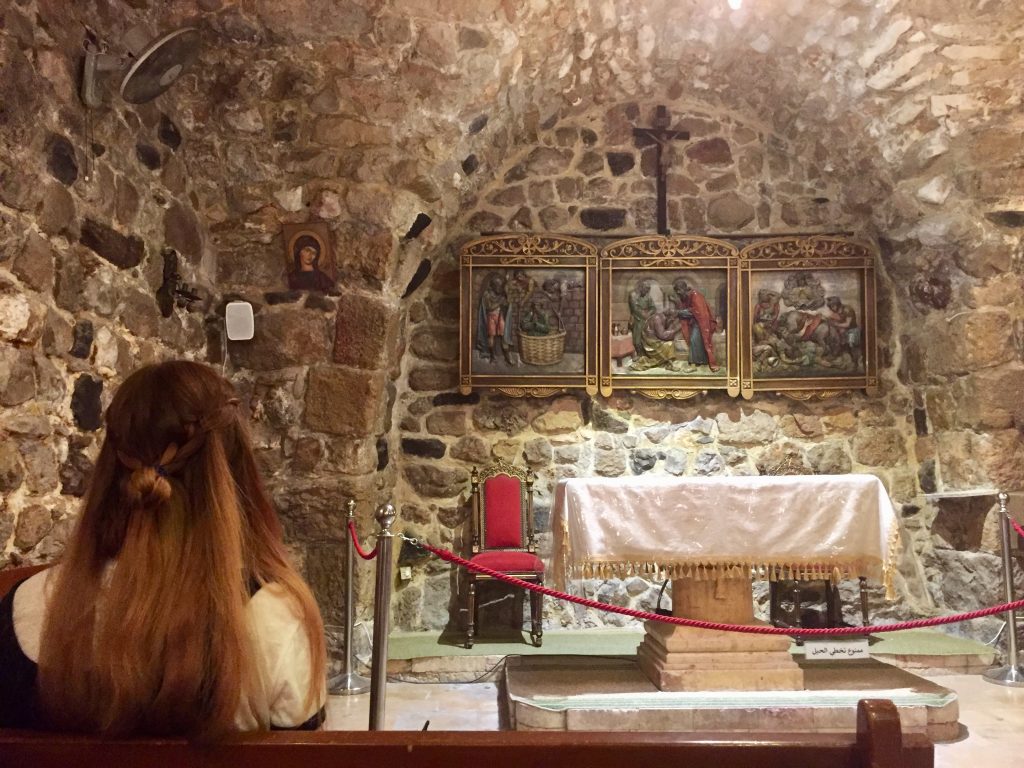
These light-hearted snippets from my TED Talk of 2019 recount stories from our trip to Syria earlier that year. I yearn to get back to Damascus to see my many friends, yet I know the situation there is worse than it has ever been since the violence started there more than a dozen years ago. The US-imposed sanctions continue to cripple the country and make it impossible for people to rebuild their homes and their lives. Meanwhile the US continues to steal Syrian oil and bleed the land of its resources.
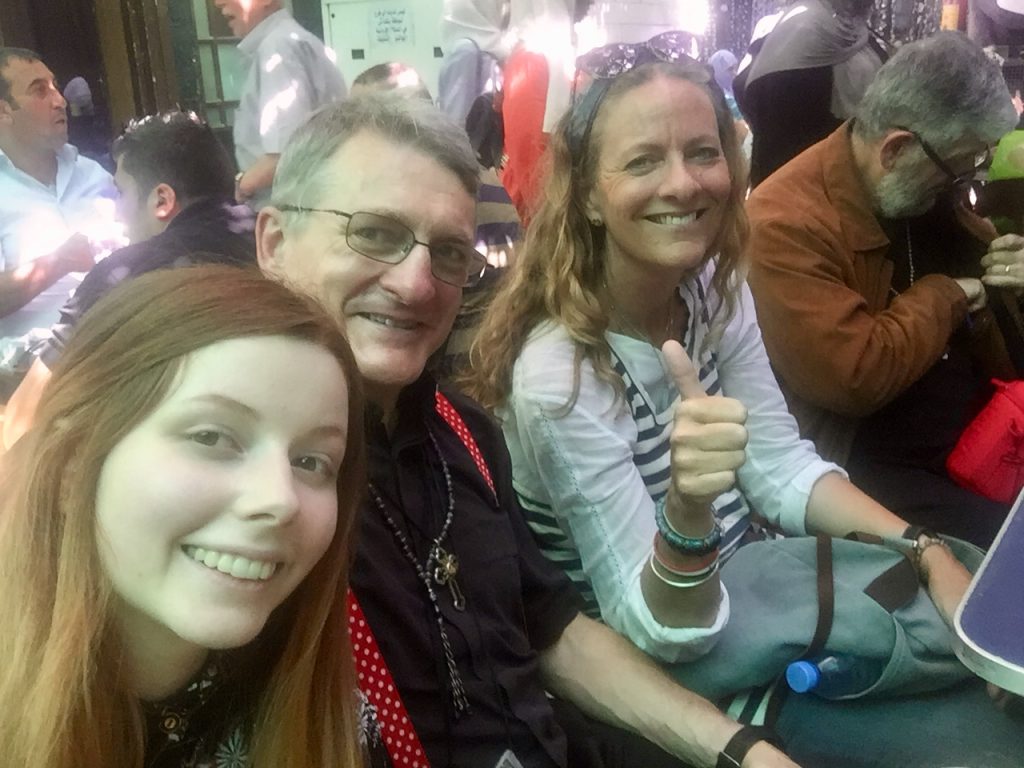
with Vanessa Beeley (R) and my daughter, Imogen (L) in Damascus in 2019
It staggers belief – the way the Israeli government continues to stage violent assaults on Syria – and all such attacks go unreported in mainline Western media. Israel and its allies continue to kick the Syrian people while they are down, yet, should Syria be able to strike back at some point, it will doubtless be reported as an ‘unprovoked attack’. Thank you, Vanessa Beeley, for continuing to shine a light into this darkness. Read her full article here. Father Dave
Israel violates Syrian airspace on a criminal assassination mission
At approximately 00.20 on the 3rd of June 2024 Israel again violated Syrian airspace to target sites in the vicinity of Aleppo, northern Syria. The Israeli jets entered Syrian air-space via Jordan and the illegal U.S. military base at Al Tanf on the border between Syria and Jordan.
The Israeli warplanes flew at very low altitude to avoid Syrian radar detection and approached the south-eastern countryside of Aleppo where they fired thirteen missiles targeting six locations in the northern countryside of Aleppo.
Needless to say there have been simultaneous intense attacks on southern Idlib and western Aleppo by the NATO/Zionist backed terrorist groups.
One area targeted was a civilian copper-smelting facility in Hayyan north of Aleppo.
The aggression led to the martyrdom of 17 soldiers from the Syrian Arab Army and allied forces including another senior IRGC advisor – Haj Saeed Abyar:
I’m pasting below an extract from Mk Bhadrakumar’s article in The Cradle, “‘Swarming’ the US in West Asia, until it folds.” It’s the most encouraging analysis of the state in Syria that I’ve read for some years. Bhadrakumar sees US influence collapsing across the region and believes that exiting the region as quickly as possible will be crucial to Biden’s campaign for reelection later this year.
It would have been gratifying if the US had stopped stealing Syrian oil and left because they realised it was the right thing to do. Even so, America’s departure will lead to much joy and thanksgiving across Syria and around the Arab world, regardless of what moviates them.
The author of this article, Ambassador MK Bhadrakumar, was a career diplomat for three decades in the Indian Foreign Service with multi-year assignments in the former Soviet Union, Pakistan, Iran, Afghanistan and Turkey.
Father Dave
Iran’s patience has run out over the US military presence in Syria and Iraq following the revival of ISIS with American support. Interestingly, Israel no longer abides by its “de-confliction” mechanism with Russia in Syria. Clearly, there is close US-Israeli cooperation in Syria and Iraq at the intelligence and operational level, which goes against Russian and Iranian interests. Needless to say, the backdrop of the imminent upgrade of the Russia-Iran strategic partnership also needs to be factored in here.
These developments are a vintage illustration of defensive deterrence. The Axis of Resistance turns out to be the principal instrument of peace for the issues of security that entangle the US and Iran. Clearly, there isn’t any method or any reasonable hope of convergence to this process, but, fortunately, the appearance of chaos in West Asia is deceiving.
Beyond the distractions of partisan argument and diplomatic ritual, one can detect the outlines of a practical solution to the Syrian stalemate that addresses the inherent security interests of the US and Iran that are embedded within an outer ring of US-China concord over the situation in West Asia.
Russia may seem an outlier for the present, but there is something in it for everyone, as the pullout of US troops opens the pathway to a Syrian settlement, which remains a top priority for Moscow and for Putin personally.
It was great to catch up with Rev. Dr. Stephen Sizer while I was in the UK in September 2023. We did the interview in a pub – The Titanic – in Southhampton.
Having made nine trips to Syria during the fighting, Stephen wanted to know how I got involved in the first place for, indeed, prior to my first trip in 2013, I wasn’t even sure where Syria was on the map! I now think of Damascus as a second home and have been given an honorary Syrian name – Abouna Abdullah.
The war on Syria is no longer front-page news, but it has never ended. Currently, the United States and its allies are placing enormous pressure on the Syrian people in an effort to topple the Syrian government. The goal is not just to replace Bashar Assad with a President more conciliatory to western goals, but rather to break the country
into small semi-autonomous states so it can never again be a centre of resistance to Israeli and U.S. domination.
The latest efforts involve a western media campaign promoting and exaggerating unrest in southern Syria. In 2011, heavily armed U.S. backed terrorists flooded the country, committing murder and mayhem across the nation. After a decade of vicious warfare, the Republic of Syria survived under the governance of the elected President, Bashar al Assad, and an elected Parliament.
Today, the fighting in Syria has largely ended, but the country suffers under onerous sanctions that make it impossible to engage in international trade or receive international aid. In the last five years, the Syrian Pound has gone from 500 to 13,000 SY Pounds per US dollar. A once self sufficient economy, Syria cannot repair factories damaged by terrorism and earthquakes; cannot replace stolen equipment; can no longer manufacture pharmaceuticals or process food.
Meanwhile, the province of Idlib continues as a terrorist enclave under Turkish protection. Turkey occupies other border areas while Israel bombs Syrian territories almost weekly. Recently Israel attacked the Aleppo international airport to disrupt an international conference focused on rebuilding Syria. On top of all these crimes,
the US has military bases and forces protecting a secessionist army and controlling nearly one third of Syria where the majority of Syrian oil and wheat come from.
While Syrians starve, aid pours into the terrorist held area in Idlib and Syrian oil wealth goes to support U.S. proxies. While Syrians go without energy for lights and heat, automobile fuel and cooking, the richest country in the world sells their gas and oil for profit. A once thriving semi-socialist state, Syria has had to cut subsidies for
food and energy and cannot pay a living wage or support the numerous veterans from the war. The Syrian health care system, once the best in the Arab world, is struggling to continue as they cannot import parts or software needed to operate hospital machinery and equipment.
Following the massive earthquake earlier this year, SSM (and other global charities) found the only way to provide aid was to hand carry resources and money into the country. We continue to support the legitimate government of Syria located in Damascus and are currently engaged in modest humanitarian projects to alleviate the suffering of ordinary Syrians as a result of 12 years of US regime change activities.
End the U.S. Occupation of Syria and Disband the U.S. SDF proxy army! End all Sanctions and Unilateral Coercive Measures against Syria! Hands off Syria!!!
It’s often hard to know what is driving the policies of Turkish President, Recep Erdogan. Is it hatred for the Kurds, his desire to control more of Syria, or simply a general drive to amass more power for himself. Whatever it is, we can be confident that his latest proposal to help rebuild Aleppo is not driven by a love for his Syrian sisters and brothers. As Steven Sahiounie writes, his plans for Aleppo seem more like a vision of annexation.
Turkey plans to annex Aleppo
by Steven Sahiounie
In the first few years of the conflict, Aleppo did not participate in the US-NATO attack on Syria for regime change. Jibhat al-Nusra saw the opportunity to surround and occupy the eastern section of Aleppo. This cut the huge city of 4 million into two: the free western section under Syrian administration, and the eastern section under the occupation of various Radical Islamic terrorist groups supported by the US and Turkey.
During the conflict years of 2014 to 2016 the terrorists dismantled the factories in Aleppo and transported the materials to Turkey where they were re-assembled by Erdogan loyalists and cronies.
After Erdogan’s terrorists destroyed the economy in Aleppo and stole the factories, now he suddenly proposes to rebuild factories and boost the economy of Aleppo. But, Erdogan is not proposing to fund or support existing Syrian businesses in Aleppo, instead under his plan Turkish businesses along the border region will develop Turkish businesses and employ Syrian workers. The workers will have an income, but the Syrian businesses will be targeted for extinction. It appears Erdogan is proposing an annexation of Aleppo and more regions in Syria.
The Syrian refugees returning to Syria would be working for Turkish businesses with no benefit for Aleppo.
Erdogan has repeatedly voiced his wish to meet with Syrian President Bashar al-Assad. Damascus has said their condition for the meeting is the complete military withdrawal of Turkish military in occupation of area in Syria, and the removal of Radical Islamic terrorist groups which Turkey has employed in Syria.
Whenever I’m tempted to relax in the thought that God is in His Heaven and all is right with the world, I remind myself of two things – the enduring torture of Julian Assange, who continues to suffer for the crime of telling the truth, and the ongoing pillaging of Syria – a country that is still paying the price for attempting to maintain independence.
Before the violence began in 2012, Syria had a largely self-sufficient economy and no foreign debt. Now it teeters on the brink of economic collapse, due almost entirely to two factors – the years of violence that were funded and maintained by foreign governments, and the ongoing regime of sanctions imposed by the US and its allies.
On top of these vile acts of aggression we must add the ongoing theft of Syria’s oil by the US. It was under the Obama administration – in November 2015 – that the US began its occupation of North-Eastern Syria (the most oil-rich area in the country). According to the Syrian Oil Ministry, the US has been stealing an average of 66,000 barrels of oil per day since then – amounting to around 80% of Syria’s overall oil production. On a geo-political level, the goal is to destroy the Syrian economy, thus advancing the US agenda in the region. For the average Syrian, the oil theft means food scarcity, as there is insufficient fuel to power farm machinery, and it means people dying from the cold during winter as they have no way of heating their homes.
In some ways the most depressing thing about the US theft of Syrian oil is that successive US administrations haven’t even bothered to come up with a reasonable excuse. It’s like the bully in the playground who steals your lunch money without pretending that he needs it. He does it because he can, and because he knows no one will try to stop him. Even so, things are changing across the Levant, and the recent reproachment between Iran and Saudia Arabia is an indication that the US is losing its relevance. They would have done well to follow the Chinese example of investing their billions in roads and infrastructure rather than on the machinery of war.
From this distance it’s often hard to see where the Spirit of God is at work in Syria. The country seems to stagger from one crisis to the next. After a dozen years of war, fires, earthquake, and all the deprivation caused by sanctions coming from the US, the fires are back! They have hit Lattakia province again – such a beautiful part of Syria, and the same region that was at the centre of the earthquakes.
I remember friends in Syria telling me how, during last year’s fires, families were crowding into the only vehicle they could find that had fuel and trying desperately to attach an olive tree to the vehicle so that they would have some food as they fled!
The natural disasters have been terrible. The man-made disasters, caused most especially by US sanctions, seem to me more terrible still. I find some comfort in the report of I’ve pasted below of the good work being done by Don Bosco House in Aleppo, which is a reminder of what the church, and other international religious organisations, can still accomplish.
While sanctions still make it impossible for most of us to send money to Syria, the church can get money across the border to fund works like this. If there were ever a time for the Christian community worldwide to step up and make a difference for people in need, now is the time!
In the immediate aftermath, Salesians opened the doors to Don Bosco House, and hundreds of people found security, companionship and relief. Five months after the earthquake, Father Alejandro León, superior of the Salesian Adolescent Jesus Province of the Middle East, reflected on what he experienced and what the country continues to need, as well as extended his gratitude for all those who have provided support.
Fr. León said, “One sentence I heard made me think. I entered a formation meeting with a group of teenagers aged 15-16. I don’t know what topic they were discussing, but one girl said, ‘Here we were taught to see the glass half full, rather than half empty, but the problem is that our glass is not only empty, it’s really broken.’ The sentence may seem to be exaggerated, or an outburst after the experience of the earthquake. However, I do not share this, but there is something in it that makes me reflect and empathize with the existential situation of these young people.”
Fr. León noted everything these youth have been through in their young lives. “They are young people who have no recollection of life without war. They have lived for years without electricity, without water, with scarcity of food and fuel. They have lived in a besieged city and have feared attacks with chemical weapons or missiles. They all mourn a family member who died during the war and live in constant economic depression. They have experienced cholera epidemics and the COVID-19 epidemic. What now? A large earthquake and other earthquakes, at least four, that exceeded 6 on the Richter scale.”
It was 4:17 a.m. on Feb. 6 when the earth shook. Immediately, the courtyard of Don Boco House filled with people seeking safety. There was anxiety and uncertainty. Father Mario Murru, rector, assured them from the outset that the Salesian house would be open for all those who needed it. At lunchtime, there were already 50 people in the house, and by dinner, there were 300. This number grew steadily in the following days to reach 500 people. On Feb. 21 another strong earthquake renewed fear, and 800 people found shelter at Don Bosco House.
Youth in the region had been attending programs at Don Bosco House for years. They were involved in youth camps and were familiar with the Salesians. Through their own training, they were natural leaders in the emergency, helping their families and neighbors. Fr. Murru said, “It was moving to see the respect that the adults paid to young people. Not because they were designated authorities, but because of the moral authority acquired through their generous service.”
He added, “Love has made us overcome barriers that none of us could have imagined. For the love of children, for the love of parents, for the love of friends, for the love of God. At a time when there was no reason to hope for anything, they found people to fight for with hope and everyone, rich and poor, became needy and shared what they had.”
Almost 2.4 million euro was raised by Salesians around the globe for emergency projects in the aftermath of the earthquake. In June, most of those emergency projects concluded to make room for reconstruction, educational projects, and summer camps for children and older youth affected by the earthquake.
I only just came across this documentary on Syria, produced by Mark Taliano. It is excellent. It’s not a shiny, big-budget production, but it’s powerful, nonetheless.
“Crimes Against Syria” is built around the anecdotes of several Americans who have become aware of what has really been going on. It features a journalist friends of mine such as Eva Bartlett and Steven Sahiounie, who are people of courage and integrity.
Having visited Syria nine times between 2013 and 2019, I am in complete agreement with the perspective of the filmmaker. Mark Taliano is a research associate of the Centre for Research on Globalization (CRG) and the author of “Voices from Syria”.
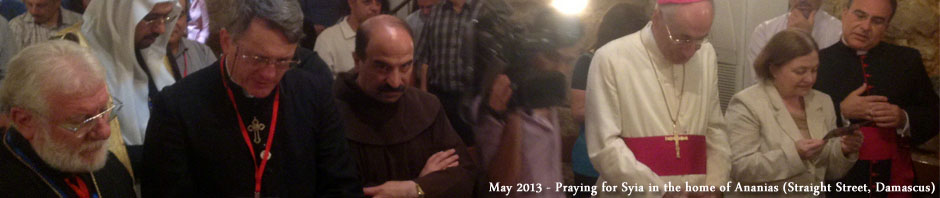
my daughter, Imogen, at the home of Ananias in Damascus
As Steven Sahiounie points out in his article below, the fighting in Syria has all but ended and yet Syrian refugees remain spread around the world. This is entirely the result of the US and European economic sanctions. The stated aim of these sanctions is to cause civil unrest, resulting in the Syrian people rising up and overthrowing their government – the government of Bashar Al Assad, which does not meet with US approval. I refer to this as the ‘stated’ goal as it’s hard to believe that the US is this naïve. There are zero examples that I am aware of where sanctions imposed by a foreign power lead to this kind of revolution. On the contrary, foreign aggression generally leads to a closer reliance on the government, which has indeed been the pattern in Syria over the last 10+ years of strife.
The sanctions damage ordinary Syrian people. I have many friends across Syria who struggle on a daily basis due to the sanctions. They have no fuel for their cars. They can’t heat their homes during winter. Their jobs (if they can get a job) pay next to nothing. Moreover, those who are sick have little chance of getting their necessary medications.
I remember when I was last in Syria, talking to a wonderful young woman who was part of a group supporting kids with cancer. She explained that for the most part this now involves only sitting with the children as they die, as they cannot get the necessary medications. Of course, those who impose the sanctions will tell you that food and medicines are exempt from sanctions which is true, so far as it goes, but those who impose the sanctions know full well that this option is never taken at a company level. The fines for trading with a sanctioned country are so high that they are designed to bankrupt any company that is caught doing so overnight. No board of directors in their right mind will allow their company to ship food and medicine to a sanctioned country lest they accidentally include a sanctioned widget (or lest their competitors tie them up in court, claiming that they did).
Sanctions thus far seem to have only strengthened the Syrian government and they do immense damage to ordinary Syrian people. Beyond that, they are also at the heart of the global Syrian refugee problem – a problem that shows no signs of abating. The chaos Sahiounie refers to in Germany is a good example, but it is only the tip of the iceberg. When will the US do the world a favour and drop these demonic sanctions. They don’t accomplish their stated aim and they do damage ordinary people in Syria and around the world. I assume that it is American pride that keeps them in place – a dogged refusal to abandon their regime-change policy and to allow the Syrian people to determine their own future. O God, have mercy.
Father Dave
The Syrian refugees in Germany face danger
Lebanese clans living in Germany, who are involved in drug trafficking, have caused death and mayhem. The German police responded to a massive brawl which broke out on June 16 in front of a restaurant in Essen that left a 23-year-old Syrian man dead, several German police officers injured, and 150 Lebanese arrested.
A Syrian family became involved in a dispute with the Lebanese, and the fight began involving hundreds of people on both sides of the conflict, and spread to other areas.
Syrian refugees number 800,000 according to a March 2021 survey. It is the largest refugee community in Germany.
The largest influx of Syrian refugees arrived in Germany from walking on foot across Europe after taking Turkish smuggling boats to Greece in the summer of 2015 when about 350,000 arrived asking for asylum. From the outset, the illegal smuggling activity is what got them to Germany. They were rewarded for breaking European immigration laws.
The Syrians since then have continued to arrive. The fighting in Syria has been over since 2017, but the country was never allowed to rebuild because of US and EU sanctions which prevent any reconstruction or creation of new jobs. The Syrians are economic migrants. They are not fleeing war, they are fleeing poverty and the sanctions which are designed to keep the Syrian people suffering. The US and EU foreign policy on Syria is to keep the citizens so poverty stricken, that they will rise up and overthrow the Damascus government. That was unable to be accomplished by the terrorists that the US and NATO employed since 2011, and it will not be possible now that the terrorists are gone.